Introduction to the Test
Phishing Email Training Service
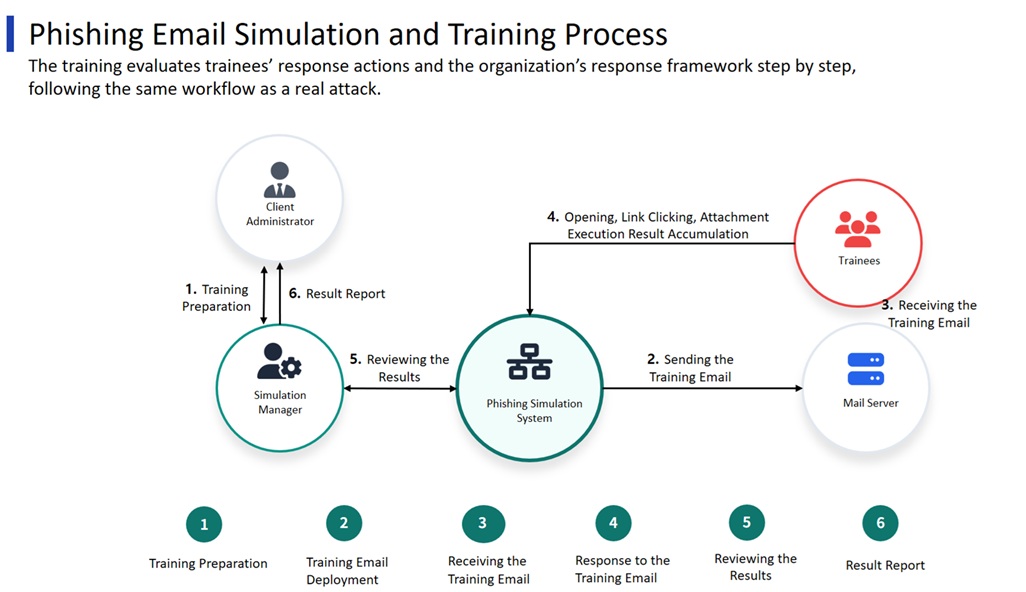
This training service diagnoses the phishing response capabilities of your organization's members and evaluates their security awareness, behavior, and vulnerability in a real-world scenario.
By designing and sending phishing emails identical to actual attacks, we analyze individual employee behavior and quantitatively identify the organization's security awareness level and weak points.
What attacks the organization is not technology, but (one click from an employee).
Ransomware - malware - personal information leakage... all start with (one email).
Hackers always attack the weakest and most easily accessible point.
WHY? The Need for Training
- The starting point of a security incident is not technology but the lack of security awareness among employees.
- 90% of all security incidents begin with an email.
- One (click) from a single employee can infect the internal network.
- Personal information leakage, ransomware infection... all start with one email.
Industry sector
Test Standard
 Risk: The Fatal Risks Created by Lack of Training
1. Incident costs are 100 times or more than the training cost.
2. Surge in risk of ransomware and personal information leakage.
3. Irrecoverable damage to reputation, customer trust, and revenue.
4. Incident accountability is often attributed to 'lack of training'.
5. Spreads to core servers in just 10 minutes after infiltration.
6. Exposure of the entire organizational sys* upon account compromise.
-
Contact Person
-
icr@icrqa.com